




Interactive Electronic Conference Proceedings
Samuel A. Rebelsky, James Ford, Kenneth Harker,
Fillia Makedon, P. Takis Metaxas,* Charles Owen
- Dartmouth College Department of Computer Science
- Dartmouth Experimental Visualization Laboratory
- 6211 Sudikoff Laboratories
- Hanover, NH 03755
- *Wellesley College
- Department of Computer Science
- 106 Central Street
- Wellesley, MA 02181
- samr@cs.dartmouth.edu
- jford@cs.dartmouth.edu
- iago@cs.dartmouth.edu
- makedon@cs.dartmouth.edu
- PMetaxas@wellesley.edu
- cowen@cs.dartmouth.edu
© ACM
Abstract
Computer technology has changed the way that conference proceedings can
be archived and presented. No longer are researchers limited to
printed text; electronic proceedings allow virtual participants in the
conference to search the proceedings for ideas, to add and share
annotations, and to create paths of related concepts through the
proceedings. Proceedings that incorporate nontextual materials, such
as audio, video, and slides from conference presentations provide
further opportunities for virtual participants.
In this demonstration of the DAGS interactive multimedia conference
proceedings, we present an electronic conference proceedings interface
that incorporates both papers and presentations. This interface
presents a wide variety of features, admits nonlinear interactions, and
suggests new roles for conference proceedings.
Keywords
Electronic Conference Proceedings; Multimedia Interfaces; Hypermedia; Academic/Educational
Applications; User-Interface Components.
ABOUT ELECTRONIC PROCEEDINGS
Although many conferences are now providing some form of electronic
proceedings (e.g., [1,,4,5]), few electronic
proceedings incorporate the wide variety of materials from a
conference, in particular, the talks presented at the conference.
However, these presentations can form an integral part of electronic
conference proceedings. Conference presentations often contain
valuable materials not found in the paper. Presentations often include
introductory and tutorial materials used to make the presentation
accessible to a broader audience. Many presentations also include
informal descriptions of both the successful and failed steps taken in
the research project. Such materials can affect the research methods
of both novices and experts. Because of the great value of
presentations, the DAGS proceedings interface includes reproductions of
presentations.
Electronic proceedings must also present a variety of features to allow
virtual participants to manage the information contained in the
proceedings. Such features include navigation utilities (both linear
and hypertext navigation), searching and indexing mechanisms, and
annotation facilities [6].
THE DAGS EXPERIENCE
The Dartmouth Institute for Advanced Graduate Studies in Parallel
Computation (DAGS) and the Dartmouth Experimental Visualization
Laboratory (DEVLAB) have collaborated in producing electronic
proceedings for the DAGS summer institutes. Although the proceedings
interface described in [2] and used for [3] was successful, we chose to redesign and
reimplement this interface for subsequent proceedings. Our primary
goals in the redesign were to simplify the interface (as some users
appeared to be overwhelmed by the plethora of features in the original
interface) and to unify the interfaces for talks and papers so that
virtual participants could employ the same features for talks that they
employed for papers.
We chose to build our own interface---rather than to use an application
like NCSA Mosaic, Adobe Acrobat, or FolioViews---because we wanted to
include features not available in these interfaces (e.g.,
reader-definable "paths of ideas") and because we needed better support
for the audio and video from presentations and for integrating and
linking corresponding portions of papers and presentations.
AN INTERFACE FOR PAPERS
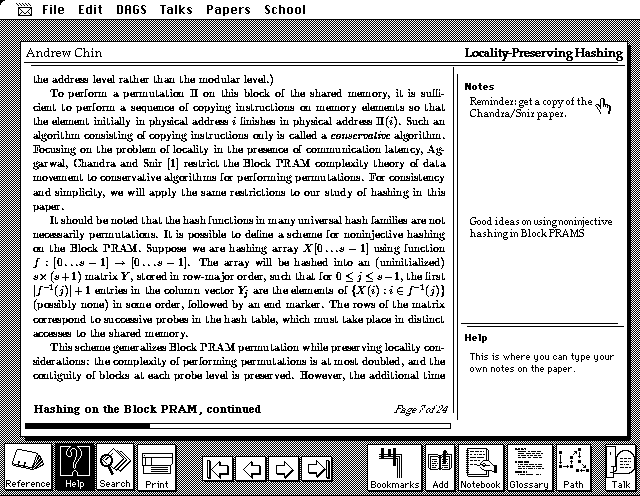
The interface used for presenting papers, shown in figure 1, models the
paper on a printed document, with the traditional "trappings" that one
expects with printed documents, including a running title, page
numbers, and room in the margin for personal annotations. Unlike some
electronic proceedings, this onscreen interface does not attempt to
precisely reproduce the printed proceedings. Many computer screens
cannot accommodate the shape and size of the printed page; hence
interfaces (such as the one used for [4]) that mimic the page force
onscreen readers to scroll in uncomfortable ways. By reformatting the
text for the screen, we simplify both reading and navigation.
Key features of this interface include four sharable forms of
annotations (marginal notes, a notebook, bookmarks, and
participant-definable paths through the proceedings); multiple forms of
searching and indexing; help mechanisms; and contextual cues to help
participants orient themselves within the proceedings. These features
also admit new uses of the proceedings. For example, faculty have used
marginal notes, notebooks, and the path facility to build lessons and
tutorials from portions of the proceedings.
Figure 1. The DAGS hypertext interface.
AN INTERFACE FOR PRESENTATIONS
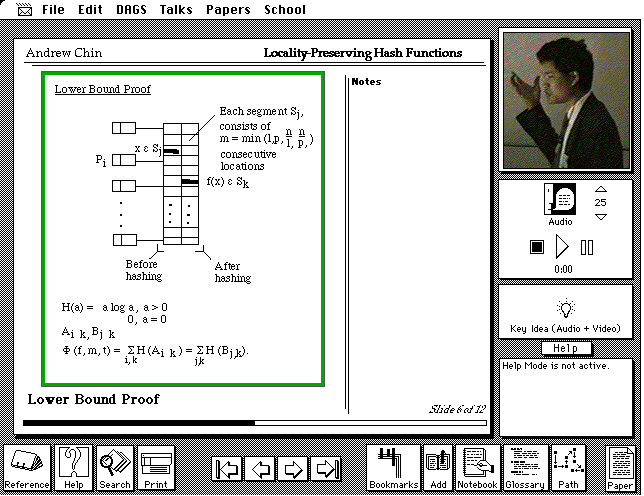
The interface for presentations, shown in figure 2, incorporates many
of the features used in the interface for papers. In addition to
viewing and listening to talk presentations, virtual participants may
also annotate slides, search for text on slides (or in notes on
slides), and include slides on paths of ideas.
Figure 2. The DAGS presentation interface.
Even after the interface for such presentations has been built and
tested, work is required to build the individual presentations. Some
of this work can be done by novices (e.g., digitizing materials), some
can be done automatically (e.g., removing periods of silence from
talks), and some requires expert work (e.g., determining links between
related sections of different documents).
CONCLUSIONS
The DAGS proceedings and their interface demonstrate that an electronic
proceedings can be more than a searchable collection of
papersproceedings can incorporate conference presentations and, by
including links and paths, can present the material in the proceedings
as a unified whole, rather than as separate documents. Such multimedia
conference presentations show promise in presenting additional
materials to researchers, introducing newcomers to a field, and in
acting as educational aids.
Acknowledgments
The DAGS institutes and the preparation of electronic proceedings for
the DAGS institutes were supported by a variety of institutions,
including the National Science Foundation (NSF grants 5-34251, 5-34294,
5-34332), the New England Consortium for Undergraduate Science
Education (NECUSE), the Dartmouth Institute for Advanced Graduate
Studies, and the Dartmouth College Presidential Scholars Fund.
References
- R. B. Allen. "Electronic Proceedings (Eprocs) for
IWANNT'93." Human Factors in Computing Systems: CHI'94 Conference
Companion, p. 287. ACM Press: New York, NY, 1994.
- M. Cheyney, P. A. Gloor, D. B. Johnson, F. Makedon,
J. W. Matthews, and P. Metaxas. "Conference on a Disk: A Successful
Experiment in Hypermedia Publishing." Educational Multimedia and
HyperMedia, 1994. AACE: Charlottesville, VA, 1994.
- P. A. Gloor, F. Makedon, and J. W. Matthews
(editors). Parallel Computation: Practical Implementation of
Algorithms and Machines. Telos/Springer-Verlag, 1993.
- Institute of Electrical and Electronics
Engineers. SuperComputing '93. IEEE Computer Society Press,
1994.
- R. Rada (prod. chair). Proceedings CD-ROM of
the First ACM International Conference on Multimedia, 1-6 August,
Anaheim, California, 1993.
- S. A. Rebelsky, F. Makedon, J. Matthews, C. Owen,
L. Bright, K. Harker, N. Toth, and P. T. Metaxas. "Building multimedia
proceedings: the roles of video in interactive electronic conference
proceedings." Dartmouth College Department of Computer Science
Technical Report PCS-TR94-241, November 1994.