





Clifford Nass, Youngme Moon, BJ Fogg, Byron Reeves, & Chris Dryer
Department of Communication
Stanford University
Stanford, CA 94305-2050, USA
phone: 415-723-5499
e-mail addresses: nass@leland.stanford.edu & youngme@leland.stanford.edu
The present study turns to the vast personality literature in the field of psychology to conceptualize personality. The goal is to find the minimum set of cues necessary to create a computer- based personality, and to determine whether these cues are sufficient to produce powerful effects. Specifically, using a laboratory experiment, we seek to demonstrate that if a computer is endowed with a set of personality markers, users will be able to identify that personality, and respond to it in a manner predicted by personality theory in the field of psychology.
This study focuses on the dominance/submissiveness dimension of interpersonal behavior. Behaviorally, dominance is marked by behavior that is self-confident, leading, self-assertive, strong, and take-charge. Submissiveness is marked by behavior that is self-doubting, weak, passive, following, and obedient [3].
We seek to demonstrate that computers can be given a personality along this single personality dimension, with powerful results. This leads to the following hypotheses:
Hypothesis 1: Subjects will perceive a computer with dominant characteristics as being dominant, and a computer with submissive characteristics as being submissive.
Hypothesis 2: Computers with dominant characteristics will not be perceived differently with respect to affiliation or competence, compared with a computer with submissive characteristics.
The present study attempts to demonstrate that the similarity- attraction relationship applies equally to human-computer interaction. Specifically, we have the following hypotheses:
Hypothesis 3: There will be a cross-over interaction between the user's level of dominance and the computer's level of dominance such that users will be more favorably disposed toward the computer, and more satisfied with the interaction, when the levels of dominance/submissiveness are similar.
Upon arrival, the subject was asked to work with a computer on a problem-solving task that has been used in a variety of studies involving interpersonal interaction [4].
The dependent variables were measured using a set of paper-and- pencil questionnaires. Upon completion of the interaction with the computer, subjects were asked for their perceptions of the computer and of the interaction.
In sum, the fundamental information conveyed by the computer was not manipulated. Only the style of communication was manipulated. All responses were pre-programmed. There was no natural language processing or artificial intelligence employed.
Consistent with Hypothesis 1, the dominant computer was perceived as significantly more dominant than the submissive computer (F(1,44) = 15.92, p<.001), based on a 9-item index; conversely, the submissive computer was perceived as being more submissive than the dominant computer (F(1,44) = 24.74, p<.001), based on a 5-item index.
Consistent with hypothesis 2, subjects did not rate the computers differently with respect to affiliation (F(1,44) = 1.32, p<.26) or competence (F(1,44) = 1.31, p<.26), based on 5-item and 12- item indices.
Hypothesis 3 predicted that subjects would prefer to interact with a computer that was similar in personality to themselves, i.e., dominant subjects would prefer the dominant computer, whereas submissive subjects would prefer the submissive computer. The results supported this hypothesis. When the person and the computer had similar personalities, the computer was given higher affiliation ratings (F(1,44) = 4.28, p<.05; 5-item index), and higher competence ratings (F(1,44) = 11.60, p<.001; 12-item index) compared to when the person and the computer had different personalities.
In addition, subjects matched with similar computers found the interaction to be more satisfying (F(1,44) = 5.18, p<.;<.05; 7-item index) compared to subjects matched with dissimilar computers.
Finally, when the subject and computer shared personality types, subjects were more satisfied with their own performance, compared to when the subject and computer had different personality types (F(1,44) = 9.02, p <<.005).
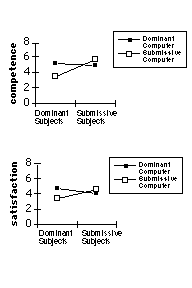
FIGURE 1: Mean Levels of Competence and Satisfaction by Subject and Computer Personality
Another implication is that humans respond socially to technologies. Indeed, this study provides additional evidence that the "Computers are Social Actors" paradigm [5] is a powerful and accurate description of human-computer interaction. The CASA studies have demonstrated that the social rules guiding human- human interaction apply equally to human- computer interaction. And like these CASA studies, the present study presents evidence that human-computer interaction is fundamentally social and interpersonal.