Abstract
Pointing movements with the hand were used to control directly a cursor to point to targets on a graphical
display with different gain settings. A detailed analysis of both the cursor and hand movements showed
how features of the movements scale over a wide range of distances and target widths. Cursor movements
showed gain effects, while hand movements were relatively unaffected by gain. The results suggest that
considering the behaviour of the hand, rather than the cursor, will lead to more effective modelling of
human performance with certain types of pointing devices.
Keywords:
Human performance modelling, input devices, Fitts' law, pointing.
Introduction
Pointing movements are elemental in many forms of human-computer interaction with 2D and 3D graphical
displays. Here we attempt to make a connection between research on human perceptual-motor processes in
dealing with the physical world, and more abstract interactions with pointing devices. Fitts' law is widely
used to describe speed-accuracy tradeoffs in both contexts [2]: movement time (MT) = a + b ID, where ID
is log(2A/W). A is the distance to be covered and W the width of a target. Numerous studies in the HCI
literature have analyzed the behaviour of a cursor, and report widely varying measures (values of a and b)
for similar processes [2].
Human pointing movements can be analyzed in terms of two phases: an initial planned impulse to a peak
velocity, and a further deceleration to the target under current control [5]. The timing and magnitude of the
first velocity peak may be a function of the distance to be covered [3]. Others [1] have shown that for equal
ID, the shape of the velocity profile of the movement is asymmetrical, more time being spent in deceleration
as target width decreases. For a pointing device using various gain settings, there are two distances to
consider: distance of the hand movement, and distance of the cursor movement on the display. There are
also and two widths: visual size on the display, and width as an accuracy constraint for hand movement.
This study uses the finger of the hand as an input device, making pointing movements, as studied by human
movement researchers, to control directly a cursor on a display. By varying the gain we address the
question of whether distance and width in display space or hand space better describe the systematic effects
on movement kinematics discussed above.
METHOD
Subjects
Six right-handed university students who had some experience with pointing devices were paid to
participate in the study.
Equipment
An OPTOTRAK system (Northern Digital, Waterloo) was used to sample (60 Hz) and record in three
dimensions the position of infrared markers placed on the subjects' index finger. Position data were
projected in real time on a reference frame in the plane of the table top, and used to control the position and
orientation of a cursor (red arrow, 3 by 1 cm) on an SGI Indigo graphics display. Targets were represented
on the screen as white circles on a black background.
Procedure
The subject placed the right hand on a table to the right of the display, index finger extended. With the
cursor positioned on a start mark, a target was presented on the display, and the right index finger was used
to point as quickly as possible to a spot on the table top so as to position the tip of the red arrow anywhere
inside the displayed target.
Three blocks of trials were performed with a different gain setting (1, 2, and 4) for each block. A practice
session before each block allowed the subject's performance to stabilize before performing trials. Five
different target widths (3 to 48 mm) and distances (19 to 300 mm) were used in combination. The order of
presentation of gain was counterbalanced, while width and distance combinations were randomized to
appear 12 times in each block of trials.
RESULTS
Data for cursor and index finger position were processed to yield tangential velocity profiles for each trial.
Four kinematic features were were analyzed as dependent measures. Using a subset of width and distance
combinations within blocks, gain (3) by distance (3) by width (3) analyses were performed separately for
both display space and hand space using ANOVA with repeated measures. Significant effects are outlined
below for: movement time (MT), peak velocity (pv) along the path of the movement, time to peak velocity
(tpv), and per cent time after the first deceleration peak (ptapd). All results summarised in
Table 1 and Table 2
are significant to p < .001, with the exception of those marked with a * (p < .05).
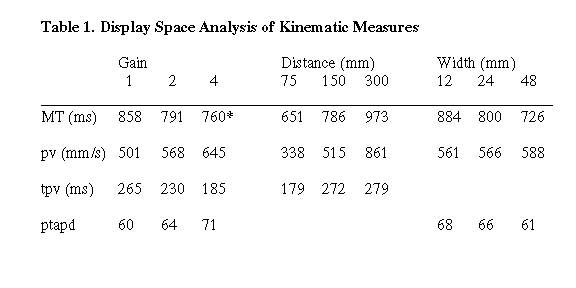 TABLE 1
 TABLE 2
Movement Time (MT)
In both analyses, MT increased with larger distances and smaller targets, as predicted by Fitts' law. Viewed
from display space, movement time decreased considerably with increasing gain. No gain effect was
evident in hand space.
Multiple regression on the combined data provided a mediocre fit to Fitts' model. In this case,
MT(ms) = 352 + 118 ID,
with a multiple R squared of .75. A better fit was provided by Welford's model [4] which separates the
distance-covering and visual control mechanisms:
MT = a logA - b logW + c.
In this case,
MT(ms) = 153 logA - 83 logW + 129
with a multiple R squared of .97.
Peak Velocity and Time to Peak Velocity
In display space and hand space, peak velocity increased markedly with increasing distance, with small
effects for target width and gain. In display space, there was a large decrease in time to peak velocity with
higher gains. Both analyses showed a clearly separable effect of distance in the
timing of peak velocity, independent of target width.
Per Cent Time After Peak Deceleration
Both analyses showed a separable effect of width on the proportion of time spent in deceleration to the
target, independent of distance. In display space, there was a large effect of gain, with higher gains
increasing the proportion of time in deceleration.
DISCUSSION
As in other studies [4] involving large variations in distance, target width has less effect than distance on
movement time, even though Fitts' model holds for small subsets of the data. One interpretation is that in
HCI, hand and display space are not superimposed, requiring a cognitive strategy to use vision to control
the endpoint rather than a more direct visuomotor mechanism, reducing the sensitivity of the channel for
visual control. Viewed from display space, gain affects the scale of hand movements, and thus alters
movement times for equal IDs. The timing of peak velocity of the hand is a good predictor of its final
position independent of gain, whereas the overall shape of the velocity profile is affected by the width in
hand space, regardless of gain.
Overall, the hand space analysis shows a simpler and clearer picture, providing evidence that distance and
target width in hand space affect the spatiotemporal characteristics of pointing movements. This suggests
that, for pointing devices like a mouse or tablet, analysis and modelling can be done more effectively by
considering the hand actions required for a task, regardless of the scale of the display.
References
1. MacKenzie, C.L., Marteniuk, R.G., Dugas, C., and Eickmeier, B. (1987). Three-dimensional movement
trajectories in Fitts' task: Implications for motor control. QJEP, 39A, 629-647.
2. MacKenzie, S. (1992a). Fitts' law as a research and design tool in human-computer interaction.
Human-Computer Interaction, 7, 91-139.
3. Walker, N., Meyer, D.E., Smelcer, J.B. (1993). Spatial and temporal characteristics of rapid cursor-
positioning movements with electromechanical mice in human-computer interaction. Human
Factors, 35(3), 431-458.
4. Welford, A.T. (1968) Fundamentals of Skill. London: Methuen.
5. Woodworth, R. (1899). The accuracy of voluntary movement, Psych. Review Monograph
Supplement, 3.